
The Return
Some things are easier to buy than to replace.
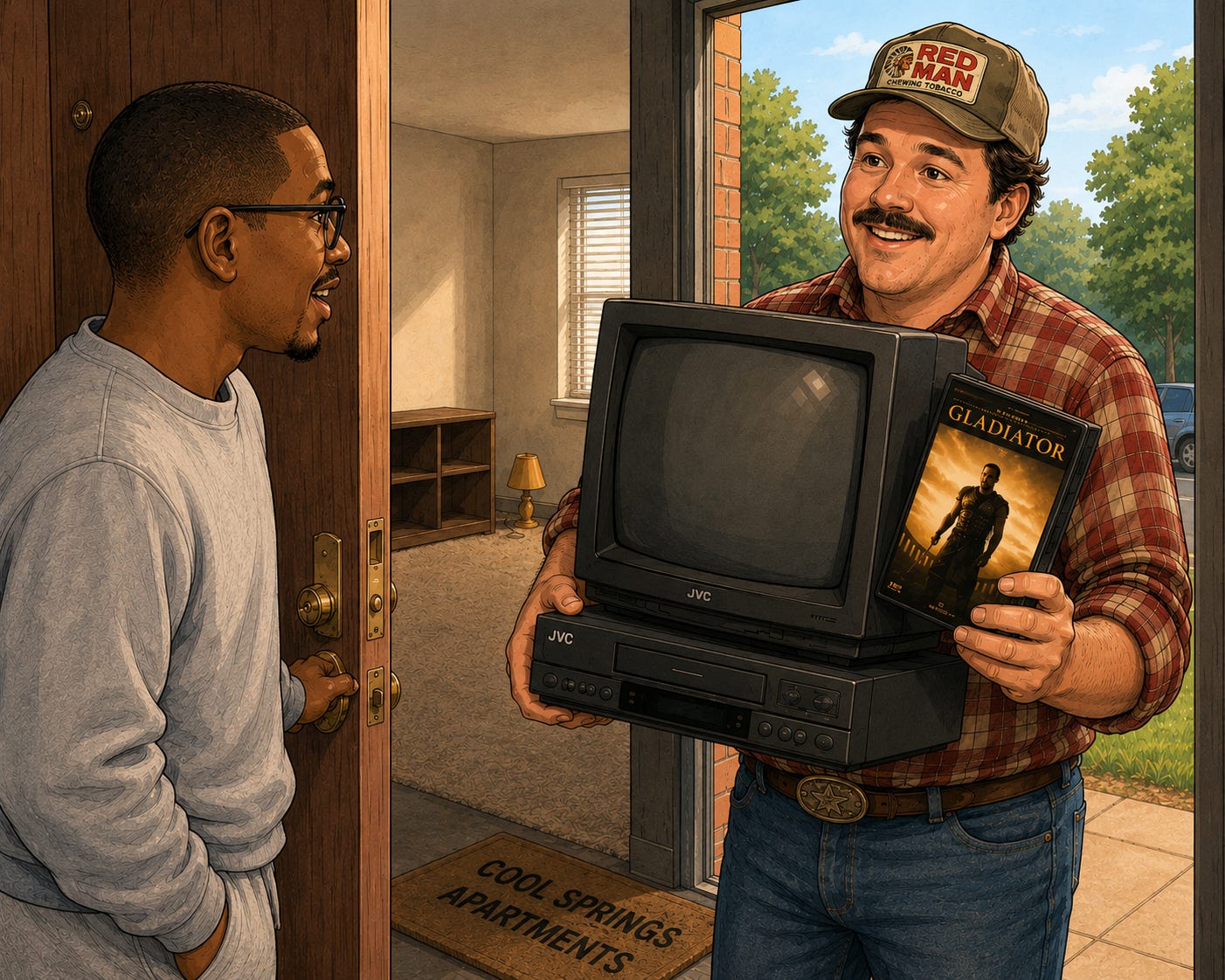
I do not remember what I was doing when the knock came, though I can tell you with complete confidence what I was not doing, which was trusting anybody.
This was one of those seasons in life when every conversation felt dangerous, every question seemed to contain a hidden agenda, and every well-meant expression of concern sounded suspiciously like the opening line of an interrogation. I had recently begun telling a few people at work that I was getting divorced, which was itself a remarkable achievement considering that, until only a few weeks earlier, I had devoted a considerable amount of energy to convincing both myself and everyone around me that everything was fine, or at least fine enough to survive another meeting, another dinner, another school event, another day in which the life I had built could continue to pass for the life I was living.
The performance had become exhausting, though not nearly as exhausting as maintaining the illusion that there had been no performance in the first place.
At Vanderbilt, I was still attending meetings, still teaching, still writing papers, still doing all the things ambitious faculty members were expected to do, and from a distance, my life probably looked almost exactly as it had six months earlier. Up close, however, it became increasingly clear that I was playing the role of a person whose life made sense when, in fact, it no longer did, and I began to suspect that the audience had noticed that the actor was no longer entirely sure of his lines.
I had always been fairly good at making things make sense. Medicine rewards that skill. Academia practically requires it. You gather information, construct a theory, identify the variables, solve a problem, and move on to the next one. If you do it well enough, and often enough, people eventually begin introducing you as an expert, which is flattering until you discover there are certain problems for which expertise is roughly as useful as an umbrella in a hurricane.
My marriage was one of those problems.
What followed after I told my wife that I was struggling with the realization that I was gay was not a dramatic moment of liberation, at least not in the way stories sometimes make liberation appear, with doors flung open and light streaming into a room. It was paperwork, difficult conversations, hurt feelings, uncertainty, a growing sense that there was no version of the next year in which everybody would emerge unhurt, and a sparsely furnished apartment at the Alara Apartments in Cool Springs, Tennessee.
Even calling it a realization makes the experience sound cleaner than it was. By the time I finally spoke the words aloud and we decided to separate, I was a faculty member at Vanderbilt, a husband, a father to a five-year-old daughter named Natalie, and a man trying to reconcile two versions of his life that could no longer coexist, while keeping as much of the entire situation as possible from becoming anybody else’s business. I told one friend the day it happened, partly because I trusted her and partly because she had a mattress I could borrow, which is a practical detail that should probably be included in more accounts of personal crisis, since the collapse of a marriage may be emotionally complicated but a five-year-old still needs somewhere to sleep.
When I moved out, my attention shifted away from myself almost immediately and toward Natalie, who was blissfully unaware of anything different and, for a while, I intended to keep it that way. I rented an apartment near the pool because she loved to swim, made sure I was close enough to her school that I could still appear at events without becoming the father who had moved to the other side of the county and begun communicating through congratulatory cards, and took her to familiar restaurants so that at least some of the scenery of her life would remain recognizable.
The apartment itself was actually a terrific find. It had been freshly painted and carpeted, had room for a washer and dryer, and sat close enough to everything that I could convince myself I had made a prudent adult decision rather than a panicked one. There was, however, one small complication: it had no furniture, no washer, no dryer, no towels, no dishes, no pots and pans, and no indication that anyone who had ever lived there had intended to prepare a meal, braid a child’s hair, or survive a week without buying something at Target.
I solved the furniture problem first by renting enough of it to create the impression that I had not simply wandered into an empty apartment and decided to remain there indefinitely. But once Natalie’s first weekend with me approached, I found myself chasing the rest of domestic life with the concentration of a man trying to catch a parade from behind.
I had a microwave but no plates.
I had frozen peas but no pots.
I had a bathroom, though only one, but no towels, no hair products, and no dental supplies for a five-year-old girl whose sense of normalcy depended in part on the apparently radical idea that she should not have to brush her teeth with soap and a finger.
At some point I found a website intended to instruct newly divorced fathers in the ordinary business of keeping children alive and reasonably content. I made a list and took it to Costco, which in retrospect was probably the wrong place for someone trying to regain a sense of proportion, since Costco does not sell one of anything and seems built on the assumption that every household has a freezer, a minivan, three cousins, and an underground bunker.
The aisle of paper goods alone nearly defeated me. There were enough rolls of toilet paper to prepare a family for a minor siege, enough paper towels to absorb a flood, and enough toothpaste to suggest that perhaps I was not simply beginning a new household but opening a dental practice. I stood there trying to determine whether I needed a frying pan, a saucepan, or whatever mysterious piece of cookware had been designed for people who knew the difference between sautéing and merely heating something until it looked done.
Some pans were nonstick. Some were stainless steel. Some were cast iron. Some were advertised as professional grade, which felt unnecessarily confrontational. I was not trying to become a professional pan user. I was trying to make scrambled eggs.
The towel section was no better. There were bath towels, hand towels, washcloths, guest towels, decorative towels, and what appeared to be ceremonial towels, intended solely for display and likely offended by the idea of actual moisture. I bought several of each, possibly too many, and at some point found myself pushing a cart through Costco with the haunted expression of a man simultaneously preparing for a camping trip, a natural disaster, and a custody hearing.
I began singing to myself as I wheeled the cart toward the checkout line, partly because I was trying to make myself laugh and partly because the alternative was standing there under fluorescent lighting and admitting that I had no clear idea how many rolls of Charmin constituted responsible fatherhood.
“On the twelfth separation day, Costco sold to me,” I sang quietly, “twelve rolls of Charmin, eleven pots and pans, ten tubes of toothpaste, nine burger patties…”
I never finished the song. I am not sure whether that was because I lost track of the inventory or because I realized that, however funny the situation seemed from the outside, I was trying to build a life from aisle markers.
Natalie, meanwhile, was five, which meant she viewed all of this upheaval with the calm confidence of someone who had never paid a mortgage, hired a lawyer, or spent a quiet evening wondering whether she had accidentally detonated the future she thought she was going to have. Children possess an extraordinary ability to continue being children while the adults around them are quietly coming apart. I admired that quality in her. I also, on occasion, resented it.
For her one-night visits to be with me, I tried to preserve the illusion that the apartment was temporary. I drove different routes to the same complex, took her to hotels in the area so she might think we were merely on unusual work trips together, and did my best to keep the mechanics of separation hidden inside what I hoped would look like a series of adventures with Dad.
Then one evening the apartment phone rang.
Natalie looked up and asked, with the casual curiosity children reserve for questions capable of dismantling an entire adult narrative, “Dad, how do they know the number here?”
She thought the apartment was another hotel.
Even now, decades later, I cannot decide whether that memory is funny or heartbreaking. Most likely it is both.
What strikes me now is that none of this was particularly characteristic of me. I have never been the sort of person who disappears for long. Most of the important things that happened in my life happened because somebody was standing nearby when they happened, whether that somebody was a mentor, a collaborator, a friend, a family member, or simply a person generous enough to see more in me than I saw in myself. Looking back, it is difficult to find a meaningful accomplishment, relationship, opportunity, or turning point that was not, in some way, a group project.
Yet somewhere between the secrecy of realizing I was gay, the collapse of my marriage, the embarrassment of starting over, and the exhausting business of trying to manage everyone else’s feelings while barely understanding my own, I began retreating. I withdrew socially and emotionally. I stopped volunteering information, stopped asking for help, stopped doing the very thing that had helped me survive every other difficult period of my life, which was letting other people walk beside me.
At the time, I told myself I was being responsible.
Looking back, I was lonely and calling it strength.
It was during that period that Bobby came to see me.
Bobby was perhaps the most Southern person I had ever met in my life, with a thick accent, a warm laugh, a permanent supply of chewing tobacco, and a manner so unhurried that he seemed capable of making even an emergency feel as though it could wait until he had finished the sentence he was in. If you met him for five minutes, you assumed he was gruff and highly opinionated. Both are true. If you knew him for five years, you’d see through the gruff veneer and be enveloped by his military training. He left no man behind.
He had heard I was going through something and wanted to hear it directly from me, so he came over to the apartment and sat with me while I tried, at first, to tell the story in the way I had been telling it to everyone else: carefully, selectively, and with enough missing information that nobody could ask a question I was not prepared to answer.
I told him that Charmaine and I had separated. I told him I had moved out. I told him about Natalie, the apartment, the hotels, the furniture I had rented, the frozen peas, the Costco list, and my increasingly elaborate attempts to make permanent change look like temporary inconvenience. Bobby listened, nodding occasionally and spitting chewing tobacco juice into a paper fast-food cup with the sort of calm precision that suggested he had done this in rooms full of complicated news before.
He was quiet in a way that made silence feel less like absence than an invitation.
And so I kept talking.
Eventually I told him the thing I had barely told anyone else.
I told him I was gay.
I remember lowering my voice when I said it, even though we were alone in my apartment. I remember asking him not to tell anyone. I remember the feeling that, once the words were out, I might not be able to gather them back.
“Of course,” he said.
That was all.
No speech. No theatrical reassurance. No demand for a more orderly explanation of how a married man with a daughter had found himself here.
Just, “Of course.”
I do not know that anyone had ever made me feel safer with two words.
I told him the entire story of both how I figured it out and how pissed the news made my wife. I told him how nervous I was about how my parents and sisters would react to the news—I was to be the first in the history of my family to get divorced. I sang like I was in the witness protection program.
Eventually Bobby asked what I had in the apartment for Natalie, and I looked around at the rented furniture, the newly acquired paper towels, the still-unopened bags from Costco, and the kitchen that seemed perfectly capable of hosting a family only if nobody expected to eat.
“Not much,” I admitted.
He asked what my wife had sent with me after I moved out.
“Almost nothing.”
That answer made Bobby angry, not at me, but at the situation, or perhaps at the particular form of logic in which adults can become so consumed by their own hurt that they forget children are still trying to figure out where their toothbrushes are.
His view was simple. Whatever had happened between adults, I was still Natalie’s father. A father needed the basic tools to parent. A daughter needed a place that felt less like a temporary stop and more like a home.
He summarized that view in three words. “That’s some shit.” It captured the sentiment I should have conveyed, but couldn’t. Instead, I just smiled and laughed while he laughed back.
Then, because Bobby understood something that I was only beginning to understand, namely that grief can survive only so much uninterrupted attention before it begins charging rent, he made me go to lunch at Wolfgang Puck’s near the mall, one of my favorite restaurants in Cool Springs. We ate food I liked, talked about things that were not my marriage, and for an hour or so I tried to perform normality with enough conviction that noone at the restaurant knew the pain I was holding inside.
Looking back, I am certain Bobby saw through it all.
When lunch ended, he hugged me and told me it was going to be okay. He told me that Natalie deserved more. He told me we would talk again. Then he got into his car, I got into mine, and I returned to the apartment, where I continued the urgent work of converting an empty room into a place where a child might spend a weekend without realizing how much her father was improvising.
A couple of hours later, while I was in the bathroom putting a roll of toilet paper into the dispenser, there was another knock at the door.
At first, I assumed it was a neighbor bringing over a casserole—the standard welcome package of Tennessee. During that period of my life, I was functioning with the attention span of a man trying to assemble furniture while reading legal documents and revising every major decision he had made during the previous decade.
I opened the door.
Bobby was standing there carrying electronics.
Under one arm was a television and video player. Under the other was a stack of movies.
For a moment, I simply stared at him, not because I was surprised to see him, but because my brain could not immediately process what I was seeing. It looked less like a visit than a small-scale home invasion sponsored by Best Buy.
“Bobby,” I said, or tried to say. “What’s this? Are you guys getting divorced too? Well, you can’t…”
The joke did not land. My voice cracked in the middle of it, and the tears came so quickly that I had no chance to decide whether I wanted to prevent them. I remember turning away, going back into the apartment, apologizing for crying as though crying were an inconvenience I had created for him, and telling him that what he had done meant more than he could possibly know.
He looked at me and nodded.
“I know,” he said.
Then he told me that someone had given him the same equipment during his own divorce, that he knew what it meant to be alone in an apartment that no longer felt like home, to lose the ordinary routines that had made life feel coherent, and to wonder whether normalcy was something that could ever be recovered or whether it belonged to some other version of yourself who had vanished without warning.
“This was the same equipment a buddy gave me during my divorce,” he said, looking at me with a seriousness that made the room go quiet. “You need it more than I do now, and I expect you to give it away when the time is right, like I’m doing now.”
We carried everything inside. He helped me set it up. Then, once the television was balanced on a snack table and the video player was connected to it in whatever way video players were connected in those days, he left me there.
I sat in the apartment for a long time after he was gone, staring at that television, which was larger than anything else in the room and, for the moment, seemed to have become the center of the entire apartment.
I stopped seeing the television as entertainment for me and Natalie.
It was reassurance.
It was permission to accept what had happened without treating it as proof that I had failed at everything else.
It was a small, glowing reminder that I was still allowed to enjoy a movie, still allowed to laugh, still allowed to choose a feeling that was not terror or shame or exhaustion.
Most of all, it was proof that by trusting a friend with the truth of what was happening, I could confront the mountains ahead without pretending I had to climb every one of them alone.
Today, many years later, I think about Bobby whenever I hear people say that they do not want to burden others with their problems.
I understand the instinct. When life falls apart, many of us retreat inward, convincing ourselves that we should handle it alone, that sharing our struggles would inconvenience our friends, that the decent thing to do is keep the mess contained until we have figured out how to present it in a way that does not trouble anyone else.
But isolation creates its own echo chamber.
The thoughts that wake us at three in the morning become louder when they are heard only by us. Fears grow larger. An imagined future grows darker. The people who care about us are left standing outside a door they have not been given permission to open.
There is an old saying: If you want to go fast, go alone. If you want to go far, go together.
What Bobby taught me is that there is another truth hidden inside that proverb.
If you want to make fast decisions through hazy glasses, go alone.
If you want to make thoughtful decisions, and to give others the chance to think clearly on your behalf when you cannot, go together. Let them help you return to what made you who you were before the pain taught you to hide.
Sometimes that return begins with a friend showing up at your door carrying a television, a video player, and a few movies, reminding you that your story is never just about you, and never needs to be owned only by you.